



Education/Research


National Heritage Story
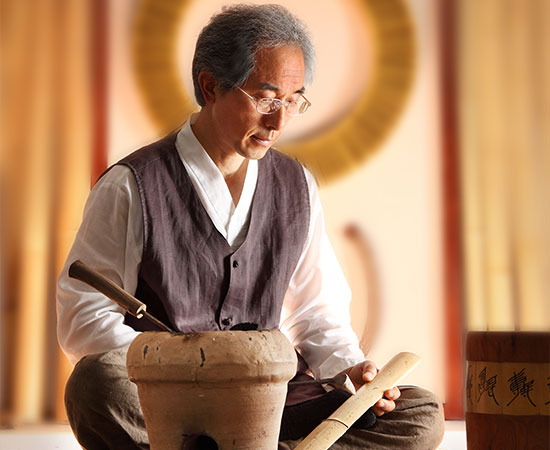
December 27, 1955~ | Bearer Recognition : July 22, 2000
Bamboo Pyrography
Lifelong Desires Carved in Bamboo
Nakjuk refers to the art of writing, drawing, and depicting patterns on the surface of bamboo with a hot iron, as well as bamboo crafts made using this technique. Although it refers to the use of an iron to create patterns and images on bamboo, any writing or drawing made with an iron on paper, bamboo, leather, silk, etc. in black color is generally called nakjuk, which is also known as nakpil and nakhwa. Nakhwa originated from the practice of branding in the olden days when people used to apply a hot brand to oxen and horses for the purpose of livestock identification. There is no literature that clearly identifies the beginning of nakhwa in Korea. In the Joseon dynasty, it seems that there were naginjang to meet the demand for applying a hot iron to general daily necessities, but nakjukjang cannot be seen in Daejeonhoetong or other Joseon dynasty titles. Therefore, it is unknown when and how it was introduced in the Joseon dynasty, but in Lee Gyu-gyeong’s Ojuyeonmunjangjeonsanggo, it is written that “In the later years of King Sunjo’s reign, there was a man named Park Chang-gyu, who was good at nakhwa.” This suggests that Park Chang-gyu was skilled in sculpture and nakjuk, but it does not mention whether he was the first person to introduce nakhwa and nakjuk to Korea.
The only tools used in the nakjuk process are an iron and a brazier. The iron is shaped differently from the iron for sewing; it is in a V shape and is curved inward, so that the body of the iron is thick like a parrot’s beak, but the tip is pointed. Two irons are prepared and placed in the brazier to be used alternately because it is necessary for them to maintain the right amount of heat. It is a matter of skill and experience on the part of the craftsman to keep the irons hot enough and to use it when it is at the ideal temperature, because if it is too hot, the color intensity of the pattern will be excessive and if it is not hot enough, the colors will be pale, there will be changes in the shade, and progress will be slow. To test the suitability of the iron, the craftsman holds it close to his cheek to feel the heat. However, proper assessment can only be made with abundant experience. When it comes to nakjuk, it is of the utmost importance to be able to use the iron efficiently to create patterns and drawings with a blend of light and shade. This is why the nakjukjang needs to be quick and have a lot of experience and training.
Nakjuk is one of the bamboo crafts that hasn’t received much attention or recognition until now, but it has been designated as a national intangible cultural property and is being passed down as one of Korea’s unique traditional crafts.
Nakjukjang Kim Gi-chan
Kim Gi-chan was born in 1955 in Bokjeong-ri, Jungbu-myeon, Gwangju-gun, Gyeonggi-do Province. His parents were middle-class farmers, so he didn’t go hungry as a child. Like most children living in the countryside at the time, he helped with farmwork and did various household chores. His father made everyday household items with straw such as meongseok, donggumi, and geolmangtae, as well as chaeban, sokuri, and samtaegi out of bush clover. His grandfather studied Chinese classics and was also skilled in medicine. He believed he got his mind, appearance, and physical constitution from his grandfather and his dexterity from his father.
From a young age, Kim Gi-chan aspired to become a self-made man. In the mid-1970s, when he was in his 20s, he met someone in need by chance, and let him have the sarangbang in his home and supported him in making pictures to sell as tourist souvenirs. This was when Kim began to take an interest in art. Later, in 1978, he traveled to the southern provinces with a group of Hallyeosudo travelers, and Songgwangsa Temple made such a strong impression on him that he returned in the fall of that year. He stayed for more than a month in an inn under Cheongnyanggak of Songgwangsa Temple. The innkeeper proposed him to marry his eldest daughter, so he married her in early 1980 and settled in the area.
After getting married, he devoted himself to his studies, learning Chinese characters for an hour every day from Songdam Lee Baek-sun and calligraphy from Sangun Kim Yeong-do in Suncheon. At the recommendation of a monk from the Gwaneumam Heritage of Mudeungsan Mountain in Gwangju, he learned how to paint landscape paintings and the Four Gracious Plants (plum, orchid, chrysanthemum and bamboo) from Gukje Lee Jong-deuk in an atelier called Jangjinhoe in Gwangju. It was around this time that he met Park Yong-gi, designated as a National Intangible Cultural Heritage, Jangdojang, who often visited the studio. At that time, Park Yong-gi wanted to stamp the jukpaedo he made in Damyang, but was not satisfied with the result and recommended Kim Gi-chan to learn the art of nakjuk. So, he went to Damyang in early 1983 and started learning nakjuk from Lee Dong-yeon (the first holder of the title nakjukjang, 1906-1985). No one else was practicing nakjuk at the time, so Kim Gi-chan became a state-funded nakjukjang student in just six months. He visited his teacher once a week, and when Lee died suddenly in 1985, he didn’t know what to do. Nevertheless, he continued practicing and exhibited his works at the Korea Annual Traditional Handicraft Art Exhibition every year. In recognition of his activities, Kim Gi-chan received a certificate of training completion from the Cultural Heritage Management Bureau (present-day Cultural Heritage Administration) three years after his teacher’s death.
In 1987, after Guk Yang-mun (1914-1998) was recognized as a nakjukjang, Kim Gi-chan became a traditional skill transfer teacher’s assistant (currently called a traditional skill transfer educator) under Mr. Guk, paving the way for him to continue the tradition of nakjuk. Thanks to the craftsmen support program initiated by Jeollanam-do Province in 1988, Kim Gi-chan studied design under Professor Kim Jong-sik of Gwangju University for about three years. He also studied woodworking with Professor Kim Byeong-rok at Dongshin University for three years from 1986. In 2000, after being recognized as a bearer of the National Intangible Cultural Property Nakjukjang, Kim opened a workshop in Songgwangsa Temple and named it Geumjukheon Craft Art Gallery. Kim says he doesn’t produce his works while thinking of selling them. This is partly because he doesn’t think the price he would be quoted would be worth the time and money he spent on making them, but this isn’t the only reason. It’s because he dreams of one day building an exhibition center where he can display the nakhwa and nakjuk works he had created and collected throughout his life.
Works
- Simjeongpiljeong Nak Brush _ Large (40 cm), Small (36 cm)
“Simjeongpiljeong” was marked on the roots of giant timber bamboo (Phyllostachys bambusoides) using the nakjuk technique in a way that there are raised and depressed parts. The container and tip are made of jujube wood, and the ring is made of silk thread.



