



Education/Research


National Heritage Story
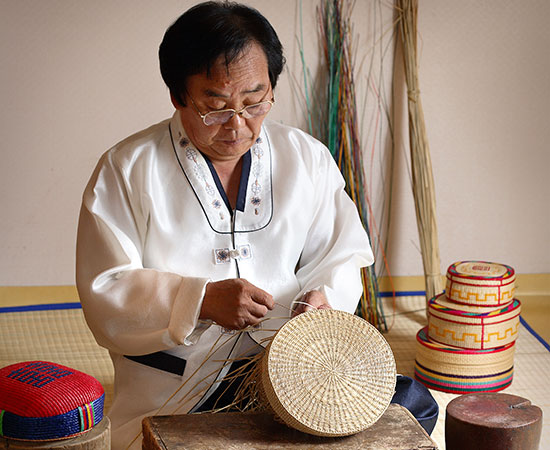
July 1, 1943 to May 24, 2023 | Bearer Recognition : May 1, 1996
Sedge Weaving
Wanchojang, the Art of Weaving Nature into People’s Lives
Wanchojang refers the art of making various household items, such as mats, cushions, and haps, from wanggol, a species of sedge called Cyperus exaltatus. Wancho refers to wanggol, which is also called hyeonwan, seongnyongcho, and yongsucho, and is used to make seats, mats, cushions, and so on. Wanggol, exquisitely and beautifully crafted by skilled craftsmen, were popular with the upper class, and they were precious items used for grains and rituals. The history of wanggol used for various purposes in the home dates back to the Three Kingdoms period. According to Samguksagi (History of the Three Kingdoms), there was a government body that was dedicated to making and delivering the necessary mats and crafts for the royal family, and records from the Joseon dynasty show that wanggol was an important trade product. In particular, the envoys who came to Korea demanded wanggol crafts, and wanggol craftsmen couldn’t keep up with the demand, which reveals just how popular wanggol crafts were at that time.
Wanggol from Ganghwa is reputed to be the finest in Korea. First of all, it is of excellent quality due to favorable climatic conditions, and craftsmanship has been passed down from ancient times. For Ganghwa wanchojang, the nogyeongsojik technique involving the use of tools is applied. There are two ways of making wanggol products: hand weaving and tool weaving. The tool weaving methods are further subdivided into nogyeongsojik, and eungyeongmiljik. Jari (mat), bangseok (seat cushion), and Ganghwa hwamunseok are made by nogyeongsojik, while dotjari and dotbangseok are made by eungyeongmiljik. The hand-weaving method involves folding the four pieces of wanggol in half, weaving a total of eight rows in a well character shape (井), and then weaving two rows. The wanggol crafts made using this technique are Ganghwa hwabangseok, kkotsamhap, and songdongi (small basket). Wanggol products have a long history as everyday items, and until now, the sole wanggol products available were rugs and containers, but considering that it is a good material that can be easily dyed and adjusted in thickness and can be used to create a variety of items without special tools, there is a lot of room for development as finished products, interior décor items, and accessories using traditional production techniques.
Wanchojang Lee Sang-jae
Lee Sang-jae, a bearer of the National Intangible Cultural Heritage, Wanchojang, was born on July 1, 1943 in Eumnae-ri, Gyodong-myeon, Ganghwa-gun, Gyeonggi-do Province, the eldest son of Mr. Lee Gyeong-myeong and Ms. Cha Cheong-rye. Even before Lee Sang-jae was born, his grandfather and his mother had been making wancho products as a side business. During the Japanese occupation, his grandfather’s and mother’s wancho products were purchased by an Anglican priest to be sent to England. After Lee Sang-jae graduated from elementary school, he began to learn the craft from his family. Gyodong was a desolate island village where rice farming was not feasible, so it had long been cultivating Cyperus exaltatus, instead of rice, and all local residents made a living by weaving wanggol.
Lee Sang-jae was 14 years old when he first encountered wanggol. After graduating from elementary school, he begged his mother to let him touch it. As a child, he suffered from polio, which resulted in a physical disability, so instead of being taught to make wide mats, he learned to make small items that could be finished while sitting in one place. He learned the basics from his grandfather, and more advanced techniques to make round samhap and seat cushions from an elderly neighbor, Yu Hyeong-sik. Gyodong-meyon hosted a wanggol craft competition once a year, and he won first place after three years of training. As a result, Lee Sang-jae gained recognition for his craftsmanship and began his journey to become a craftsman. In three years after picking up the craft at the age of 14, he began to be called “wanggol teacher/master” and was competent enough to teach the craft to others. He devoted himself to making wancho and teaching it to his neighbors. His wife, Yu Seon-ok, became mesmerized by his skills while learning wanggol craft-making from him after graduating from Gyodong Elementary School, and they married in 1970.
Handicraft researchers praise Lee Sang-jae’s wancho craft techniques. His products are said to be of high quality, with the woven part looking very even and beautiful and the arrangement and composition of the patterns such as letters and images of flowers, cranes, and so on looking very natural. In particular, his technique of connecting the inside and outside and squeezing them together so that the inside and outside match perfectly is said to be unrivaled. Lee uses the traditional method of twisting the material using a tool called a galgurakji to make the wanchono. As his craftsmanship matured, he began to create original works and won prizes in craft competitions, and his work began to be widely recognized and popular among foreigners. There are many items he makes with wanggol, including kkotsamhap, donggori, and sajuham, as well as hats, bags, shoes, and mobile phone rings. Lee Sang-jae is especially fond of pyebaek-dongguri, which is difficult to make, but is one of the most popular items.
Lee Sang-jae said that the happiest moment in his life was when he was recognized as a bearer of the National Intangible Cultural Heritage, Wanchojang, and the person he was most grateful to was his wife, Yu Seon-ok. This is because she became his hands and feet and gave him the strength to overcome their difficult financial situation. His wife, who supported him along the difficult path of wanchojang, is now an educator for the transmission of wanchojang, following in his footsteps. Yu was awarded the Presidential Prize for a refreshment ware set made of wancho at the Korea Annual Traditional Handicraft Art Exhibition1999. For a while, the couple enjoyed teaching the basics of wanggol craftwork to elementary school students in after-school programs and giving them a chance to learn about hwamunseok, a specialty product of Ganghwado Island, as well as wanggol, in addition to gaining the valuable experience of making wanggol items. Wanggol crafts, which stand out with their excellent quality and artistry among traditional grass craft-making culture, have been revived in a small workshop of about 20 m2 with a variety of crafts that combine Korean tradition and modern sensibility. The wisdom of the ancestors, who derived their livelihood from nature, has been retained thanks to Lee Sang-jae, who spent his entire life preserving and passing down the techniques of wancho making. He passed away from an illness in May 2023.
Works
- Pyebaek-dongguri / 7×7×8, 30×30×10 cm
This piece was made by weaving horizontal strips into vertically placed strips and creating a huija pattern with colored wanggol strips. A dongguri is a small basket in a flat, round shape, and it is one of the most difficult yet popular wanggol crafts to make.
- Podomun-hangari / 30×30×20 cm
This is a podomun-hangari jar featuring three-dimensional embroidery work. There are two ways to make wancho: by using hands and by using tools. Mats and seat cushions are often woven with tools, while round cushions and small items are usually made by hand. Lee Sang-jae made wancho items exclusively by hand.



