



Education/Research


National Heritage Story
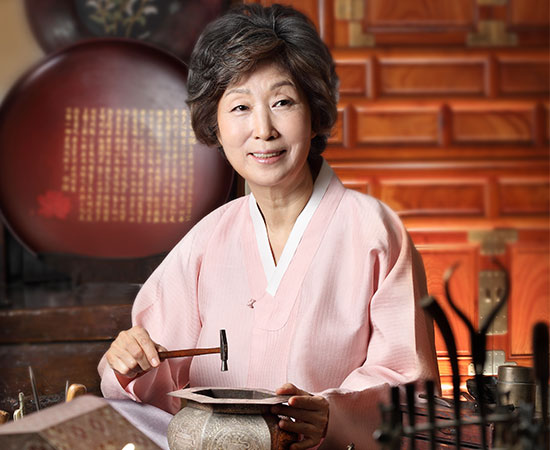
January 3, 1947~ | Bearer Recognition : March 11, 1996
Silver or Gold Inlaying
Eunsilbagi, Engraving the Beauty of the Korean Spirit
Ipsa is an inlay technique that involves digging grooves into the surface of a metal and inserting gold or silver wire as decoration. It is a traditional craft technique that demonstrates the delicate beauty of Korean metalwork, and as a technique of creating patterns by embedding gold or silver threads on metal surfaces, it has been said to be the crème de la crème of metalwork. The technique is characterized by digging or chiseling grooves on a metal surface and attaching metal wires or plates on top without soldering. With application to various metals, this technique is used across the world, with each country having its own name for it, and Koreans called it ipsa or eunsilbagi or eunipsa because silver threads were mainly used.
There are largely two ways to make ipsa. One is the ancient technique of digging thin grooves in the metal surface and embedding silver wires in them, and the other is a production technique that emerged after the middle of the Joseon dynasty and it involved placing a thin gold or silver plate or wire on a metal base and pounding on it with a hammer so that the two pieces are attached together. These methods were applied to create traditional geometric patterns such as the comb pattern on metal surfaces, as well as images such as the Four Gracious Plants (plum, orchid, chrysanthemum and bamboo).
The term sanggam was often used to describe the technique observed on metal artifacts, rather than ipsa. Sanggam is a technique in which grooves are made on the surface of a vessel and materials of different colors or textures are placed in the grooves for ornamental purposes. Unlike ipsa, which can only be applied to metals, sanggam is a broad term for decorative inlay techniques that can be applied to any material. A good example of an application of the sanggam technique is jangsikbogeom (designated as a Treasure, housed in the Gyeongju National Museum), a sword with agate embedded in gold from the 6th century Silla.
The origin of the ipsa practice in Korea can be traced back to the Three Kingdoms period. Around 20 ipsa artifacts from Baekje, Gaya, and Silla remain, and most of them are iron swords with ring pommels. The oldest ipsa artifact of Korea is chiljido from the Baekje period, which is currently stored at Isonokami Shrine in Japan, and the earliest ipsa artifact excavated in Korea is a late 4th century Baekje iron sword with a ring pommel inlaid with silver thread from Hwaseong-ri, Cheonan, Chungcheongnam-do. Such swords are mainly from the 4th and 5th century Baekje, the 5th and 6th century Gaya, and the 6th century Silla, and the ipsa technique was further developed during the Unified Silla and Goryeo periods, during which it flourished through Buddhist crafts. Ipsa crafts transitioned from mainly Buddhist items such as incense burners and ritual sprinklers in Goryeo to everyday items during the Joseon dynasty, and became more diverse with wider applications. After the middle of the Joseon dynasty, a different method of ipsa was introduced in Korea, and ipsa items made of bronze were gradually replaced by iron items decorated with silver. As the material of the base metal changed from bronze to iron, the technique of engraving patterns became significantly different, and so did the method of creating patterns and the patterns themselves. While the Goryeo dynasty saw the height of the ipsa technique, ipsa crafts began to be more common and an integral part of everyday life in the Joseon dynasty. During the Joseon dynasty, an ipsajang was appointed at a state agency to pass on the traditional techniques and create works that were needed by the state and royal court.
Ipsajang Hong Jeong-sil
Born in Pyongyang in 1947, Hong Jeong-sil was filled with a desire to learn and possess beautiful things when she was a child. After graduating from Ewha Womans High School in 1965, she enrolled in the Department of Crafts at Seoul Women’s University, and in 1969, she began her studies in art education at Seoul National University Graduate School. She then studied contemporary craft techniques under the tutelage of Kwon Gil-jung, a professor of crafts at Seoul Women’s University and a metalcraft artisan, and taught at her alma mater, Seoul Women’s University. Although she majored in contemporary metalwork as an undergrad and grad student, she was always keenly interested in Korea’s traditional metalcraft.
Then she read the book Human Cultural Property by Ye Yong-hae and grew interested in ipsa. In 1978, she often explored antique art galleries in Insa-dong, and visited the Korea Association for the Preservation of Traditional Skills in the neighborhood and became a student of Kim Jeong-seop, a bearer of the title of jogakjang, designated as a national intangible cultural heritage, thanks to an introduction by the then-secretary-general of the association. While practicing her carving skills under Kim, she learned of the 78-year-old Lee Hak-eung, who had stopped practicing carving at the age of 60, and paid him a visit to ask to become his student. In the fall of 1978, Hong learned the ipsa technique from Lee. It is said that Lee Hak-eung taught Hong with all his heart and soul, as he was pleased by the fact that she came to him, who was in his 80s at the time, to learn the national tradition.
Aware of the artistry and tradition of ipsa, Hong believed that it should be designated as a national intangible cultural heritage in order to be preserved and transmitted to future generations. So, she submitted materials related to ipsa as well as about her teacher, Lee Hak-eung, to the then Cultural Heritage Management Bureau (present-day Cultural Heritage Administration) and applied for designation as a national intangible cultural heritage. After a review by the Cultural Heritage Committee, ipsa craft (skill) and craftsman were designated as ipsajang, a national intangible cultural heritage, and Lee Hak-eung was recognized as the first bearer of the title ipsajang.
At the time, Hong was mastering her carving skills under the tutelage of Kim Jeong-seop, a bearer of the title jogakjang, as a formal jogakjang student, but at the request of Lee Hak-eung, her status was changed to an ipsajang student. She dedicated herself to mastering the ipsa technique and making related works, and was officially recognized as a traditional skill transfer teacher’s assistant (currently called a traditional skill transfer educator) in 1987. Then, after her teacher passed away in 1988, she was recognized as a bearer of the title ipsajang in 1996. Hong has also been committed to passing on her ipsa skills to future generations. In 1995, she founded the Gilgeum Craft Research Institute to create a space where she could focus on teaching ipsa. The institute was first established in Songpa-gu, Seoul, but was later relocated to the Training Center for Important Intangible Cultural Properties in Samseong-dong, Gangnam-gu after the center was founded in 1998. Those who learned ipsa at the institute include college professors, lecturers, and designers, who actively make ipsa works and even hold exhibitions.
Works
- Jukhyang_16x11x13 cm
This work combines traditional techniques with a modern household object. The body of the silver teapot was decorated with the gold and silver ipsa technique and finished with traditional otchil (lacquer).
- Silver Ipsa Bullochomun Incense Burner_22x26x25 cm
- Silver Ipsa Gilsangmun Incense Burner_29x23x24 cm



